This 10 week project with Sony Ent. involved finding technological solutions for those having a difficult time transitioning to remote work. My team and I embarked on a rigorous user research journey to really understand the psychological effects of livings ones entire life in a confined space. We focused on the topic of work-life balance and decided to create faux environmental changes to create a "mental commute" from work to home.
1. Create a browser plugin to aid in burnout from screen time and long work hours.
2 .Ease the burden of adjusting to work from home for those new to it.
3. Learn user researching and testing methods combined with psychology to apply in real time.
This case study revolved around a research-intensive project centered on investigating work-life balance, the primary focus being how to address the challenge of individuals struggling to immerse themselves in tasks due to increased distractions, leading to reduced productivity and an inability to mentally disconnect from work during personal time. The problem space guiding the research was finding ways on how to alleviate the stress and exhaustion caused by this constant mental presence. To tackle this, the project involved simulating environmental changes to establish a "mental commute" from work to home. User research methodologies encompassed interviews, online data analysis, Wizard of Oz testing, and diary studies, providing multifaceted insights into users' experiences and behaviors in this context.
Amidst the Covid-19 pandemic, many young adults have made the move to online and remote lifestyles: working, socializing, shopping and exploring the world virtually. This combined with extended screen times and static environments causes great stress, as loss of productivity while working leads to work hours bleeding into off hours.
Many young adults cited having a hard time keeping to a schedule and at home distractions as their greatest cause of productivity loss. Since stagnant environments cause halts in productivity, these young adults need a solution that imitates changes in environments while keeping them protected from Covid-19.
Not quite. Though it seemed like a relief on the surface level, there were many unprecedented side effects of living life fully at home. Some of these problems were outlined in our problem brief: eye strain from extended screen time, back problems from sitting too long, mental sluggishness from being in the same room all day, as well as having a hard time "unplugging" from work and relaxing at home. This leads us to ask,
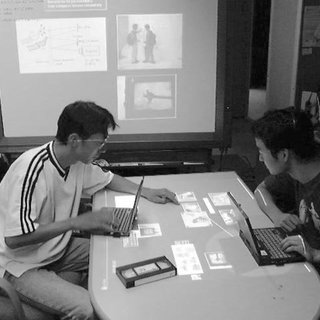
Wellner's digital desk was an old school way of combining digital with physical work through projections.
To begin our investigation into our problem space, we conducted desktop research by going into online communities (Reddit, Facebook groups, Blogs, etc.) to see how people are already balancing their work with social life. We gleaned some useful information on the topic:
1. People working from home both pre-Covid and during mentioned physically splitting spaces for work/social life.
2 .Many mentioned going about the day while maintaining a regular schedule (getting dressed, making food, "commute").
3. Wellner's Digital Desk was brought up as a tech heavy solution - a holographic desk that lets users interact with files as if they were physically on the table.
A Miro board was used to keep track of our interviewees.
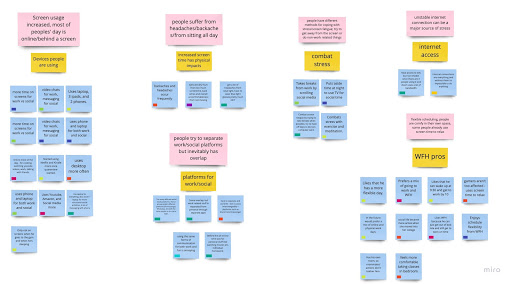
Alongside our desktop research, we conducted user interviews with young adults either in college or working full or part time remotely. The goal of these interviews were to learn as much as we could about existing habits these people had regarding work life balance. Additionally, we wanted to figure out missing user needs as our scope was extremely broad. Our key findings were that:

Additionally, we asked for pictures of current workspaces to get an understanding of how their habits worked with their setups. Between college students and recent grads, there appeared to be a large difference in their work spaces.

(Left) a college freshman, (Top right) a college senior, (Bottom right) a software engineer
We concluded that many people are already separating work/social life through scheduling (Google Calendar, planners, etc.) but it wasn't enough for them to feel comfortable to do so daily. Furthermore, a common topic brought up was the overload of screen time causing stagnant workflows; many people tried combatting this by going through the motions of "commuting" to work by going from bedroom to living room.
" It’s a different kind of tiring, I never feel like I’m really able to be productive because I’m in the same space looking at the same screen." -Anon
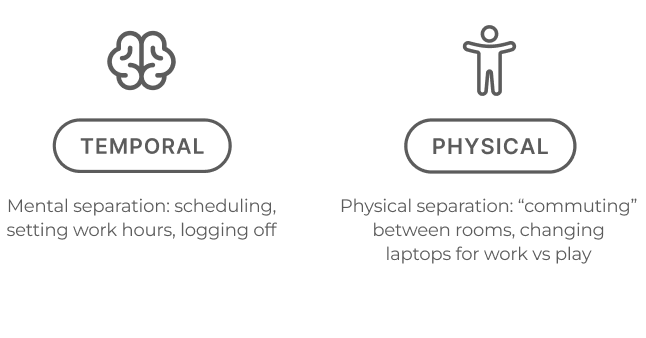
So, we strived to create the experience of two locations in a single space. We had two approaches to this idea:
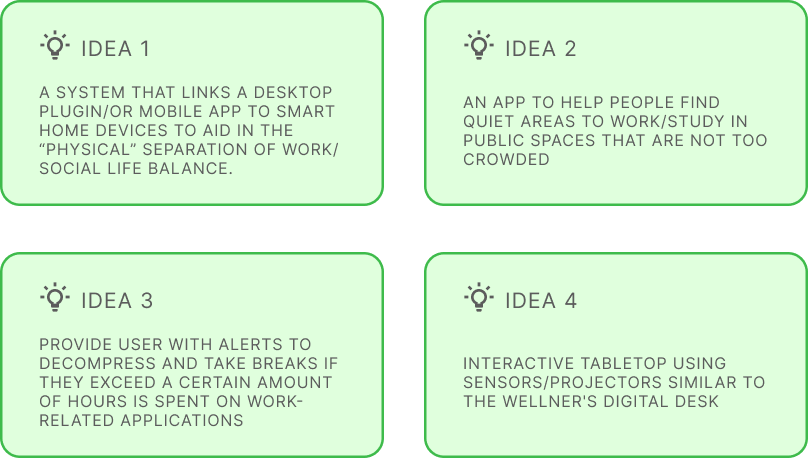
With these in mind, we threw out some quick potential solutions. We understood that at this point it may still be too early to be thinking of solutions but planned to build on these as we continued the project.
Checking in with our mentor for feedback:
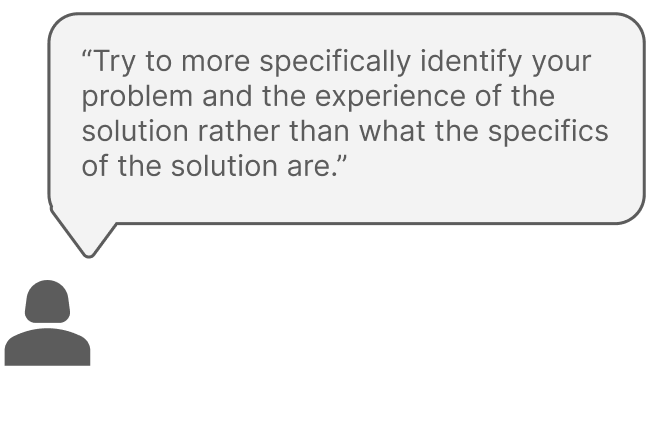
In short, we needed to narrow down our problem space as well as take a step back on our ideas. We were falling into the trap of jumping to solutions before we fully understood the user base - we instead took a second look at our data and revised or cut out some potential solutions.
Because of this, we redefined our problem space to "People find it difficult to become immersed in what they are doing due to having more distractions. They are not being as productive as they want to be while working and are mentally “on-the-clock” during personal time, leading to feelings of stress and exhaustion."
After receiving feedback, we cut down our ideas to focus on our first and third ideas - how can we provide a seamless work and relaxation experience? We revisited our initial interviewees and conducted diary studies on them - we asked to watch them work either through zoom (or in the same room if they were roommates) and kept notes on how they worked. Additionally, we asked other participants to keep a 'diary' of their activities throughout the day, specifically on their workflow.
.png)
(Top left) the student is full concentrated on schoolwork in the morning (Bottom left) by the afternoon, they are browsing shopping sites while the other screen is working (Right) the student is struggling to fight distractions while still working late at night
After conducting these studies, the same problems arose as above - users needed more space, and a way to recover from distractions. They wanted a way to feel as if they were transitioning or commuting from work to home. These studies were also incredibly helpful in showing the ways different users attempted to cope with their unique situations, which we took into account as we brainstormed solutions.
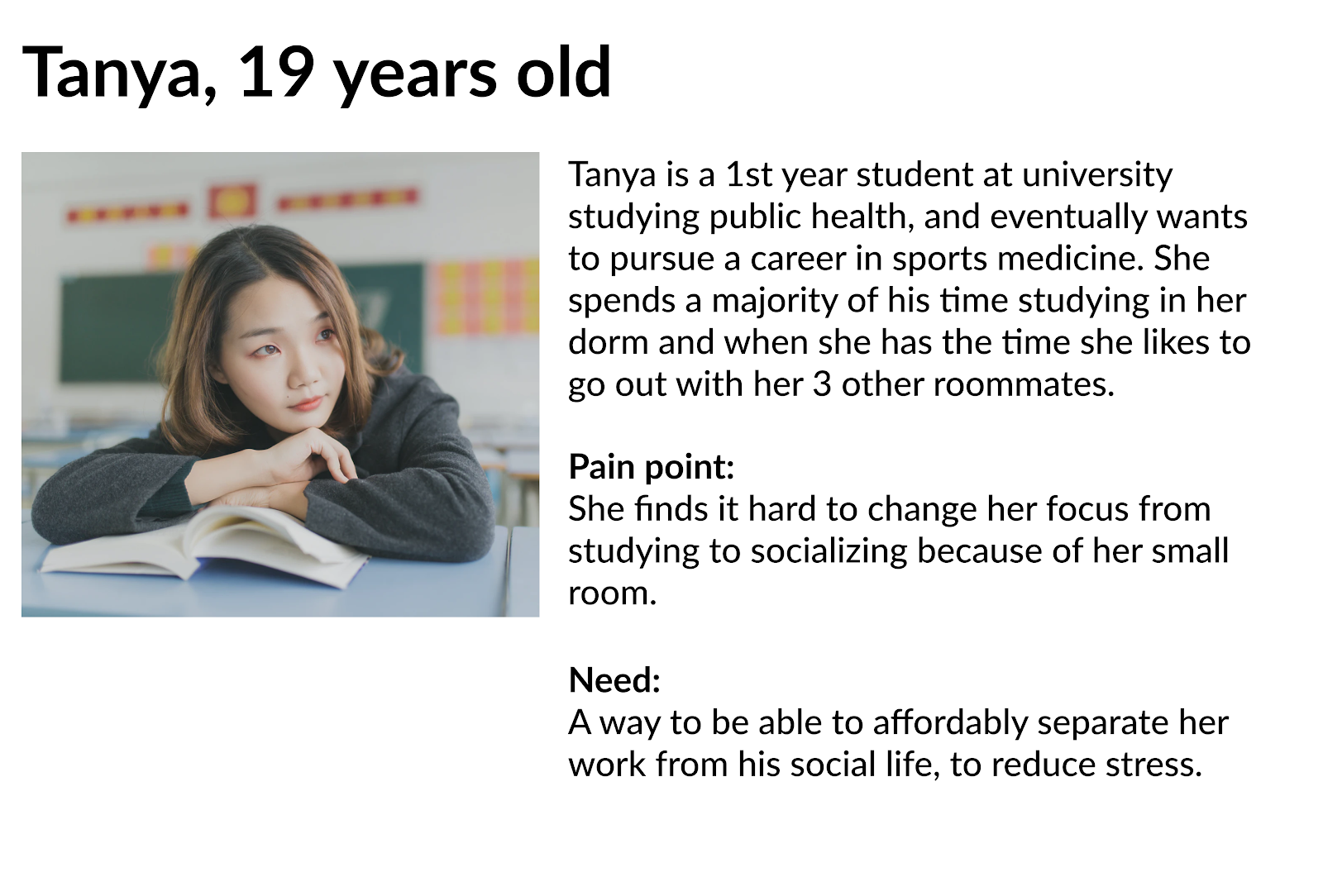
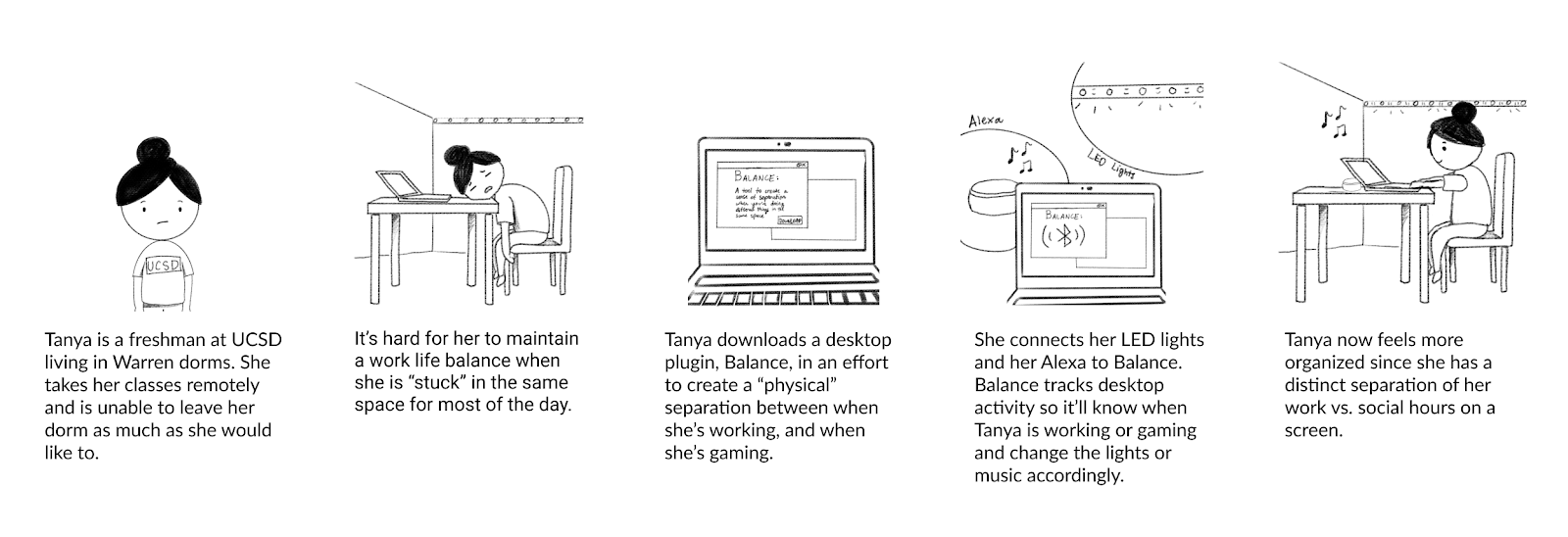
Once our diary studies were done, we compiled all the information into a general persona: Tanya, a first year college student. This would help as a reference for who we were designing for in the next stages.
We also fleshed out a storyboard for the problem at hand and how we were planning to solve it with our refined proposal: Balance, a desktop plugin or extension that would help users imitate a shift in environment as they worked.
How Balance would work: as the user changed tasks, the environment would change around them too.
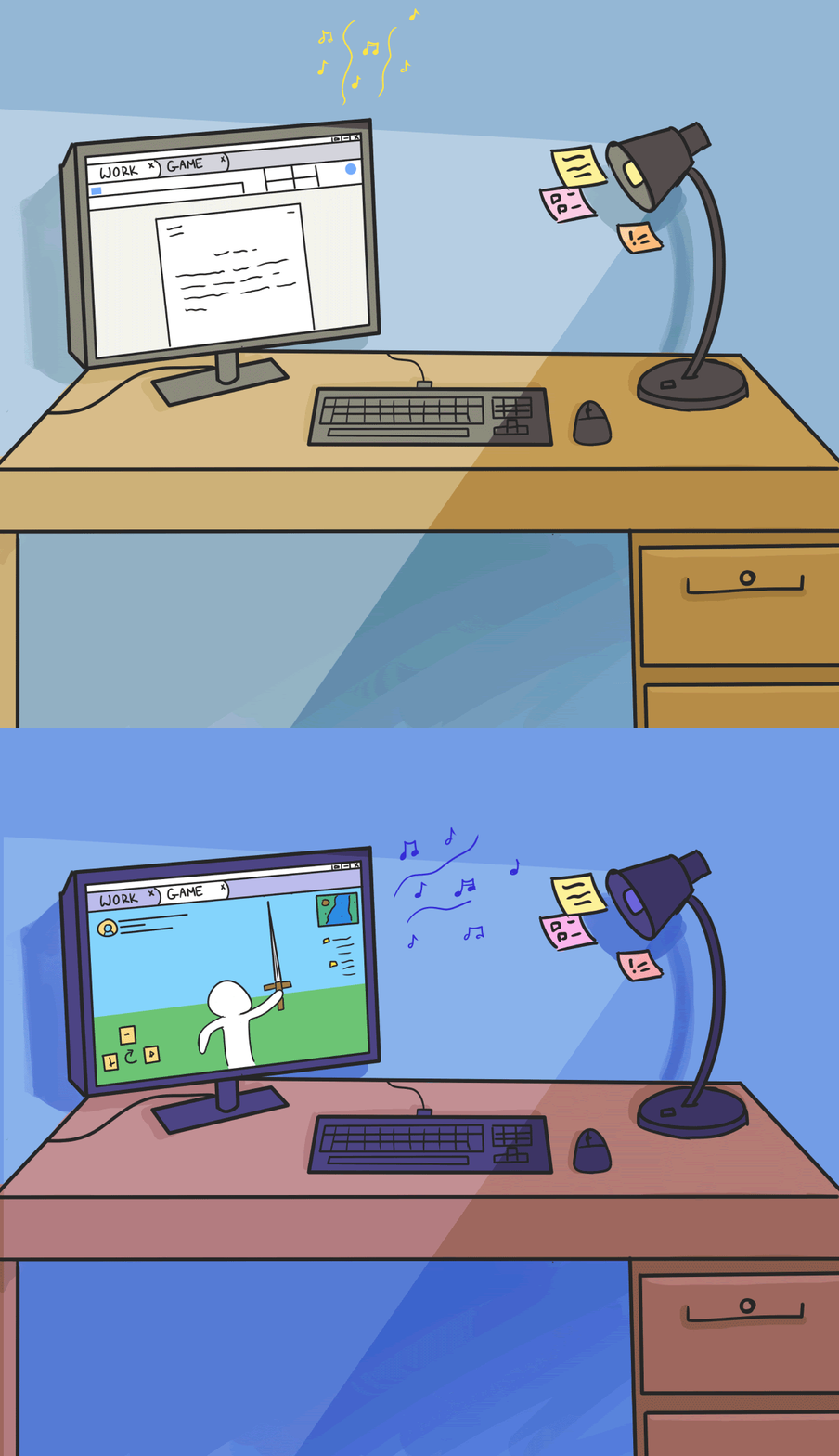
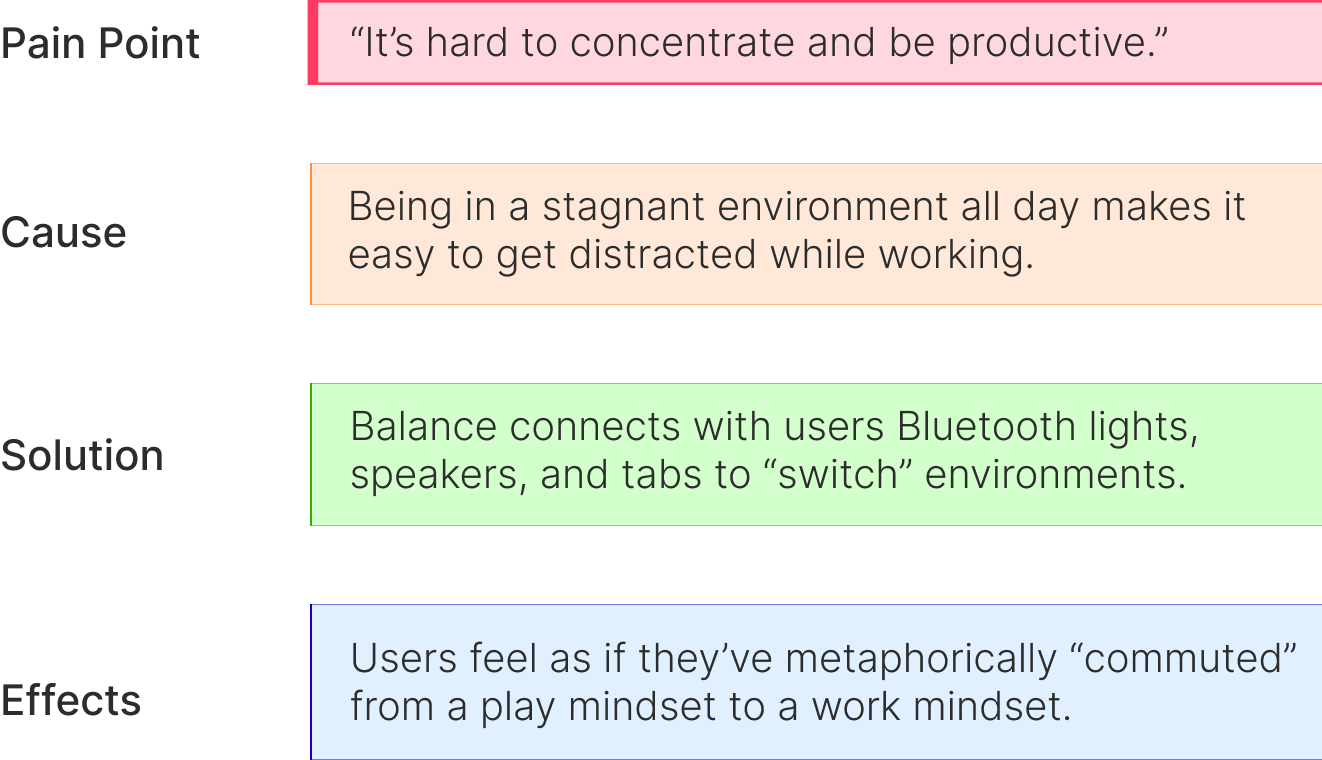
Our final solution idea was a system that links a desktop plugin/or mobile app to smart home devices to aid in the “physical” separation of work/social life balance. Based on the type of activity that the user is engaging in (work or social), the system will change the ambient settings accordingly (e.g. relaxing music for personal time, bustling café noises for studying).
1. Connecting to lights for imitated 'atmosphere' changes.
2 . Connecting to music apps to change the mood from work to relaxation.
3. Sending out an alert to selected household members during meetings for 'quiet time'.
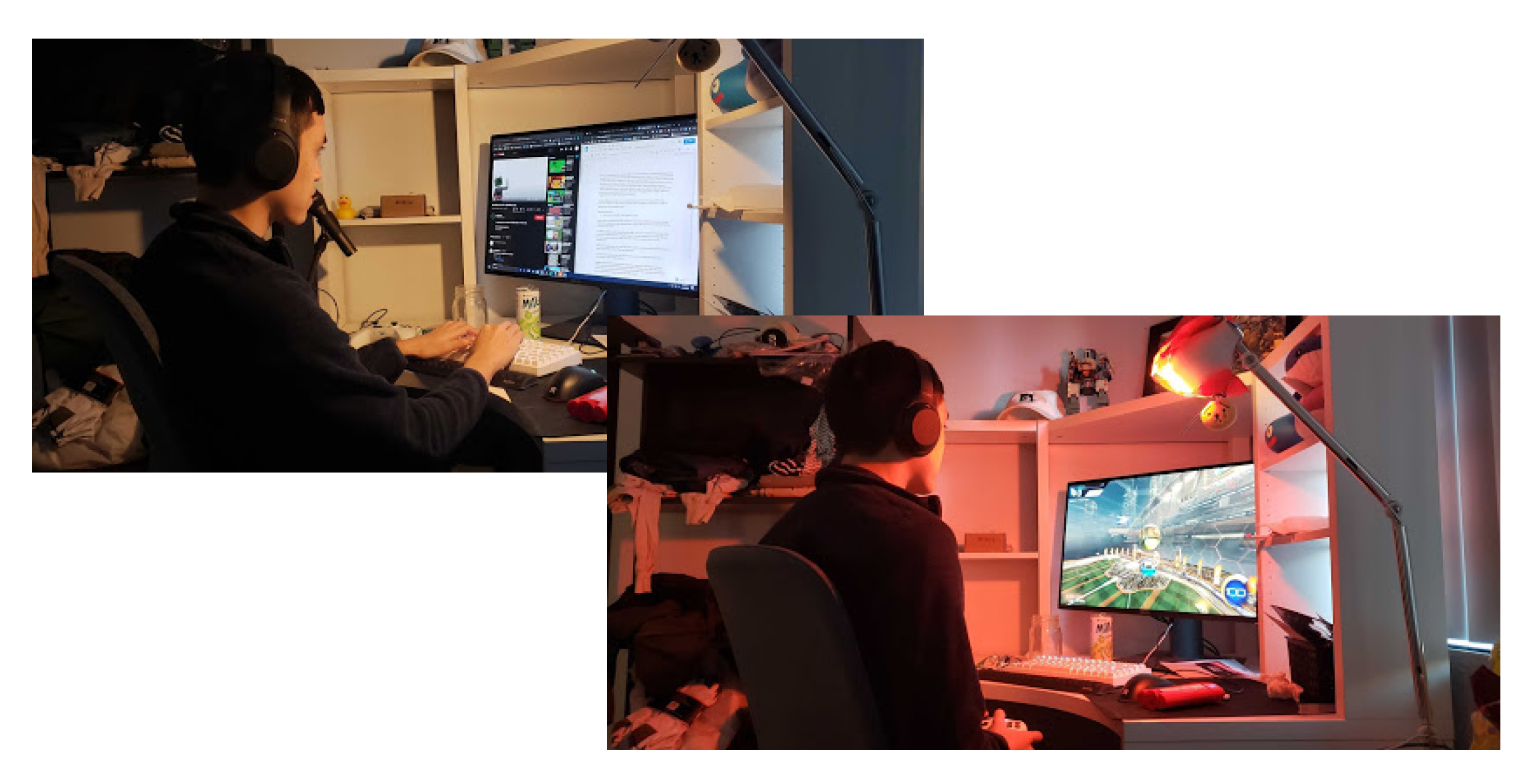
We manually changed music and lighting for users to test the validity of our prototype.
Our prototype was meant to bridge the gap between the user's temporal and physical environments - this means that our product would be fairly disruptive as it is physically changing the environment. However, we felt that this change is necessary to aid users in keeping their work lives separate from their social lives by having them slowly associate the nuanced changes to a state of mind. We proceeded to test this by manually changing the (test) user's lighting and music as we kept track of which tabs they opened. If they hopped into meetings, we would send a text to household members to keep volume low.
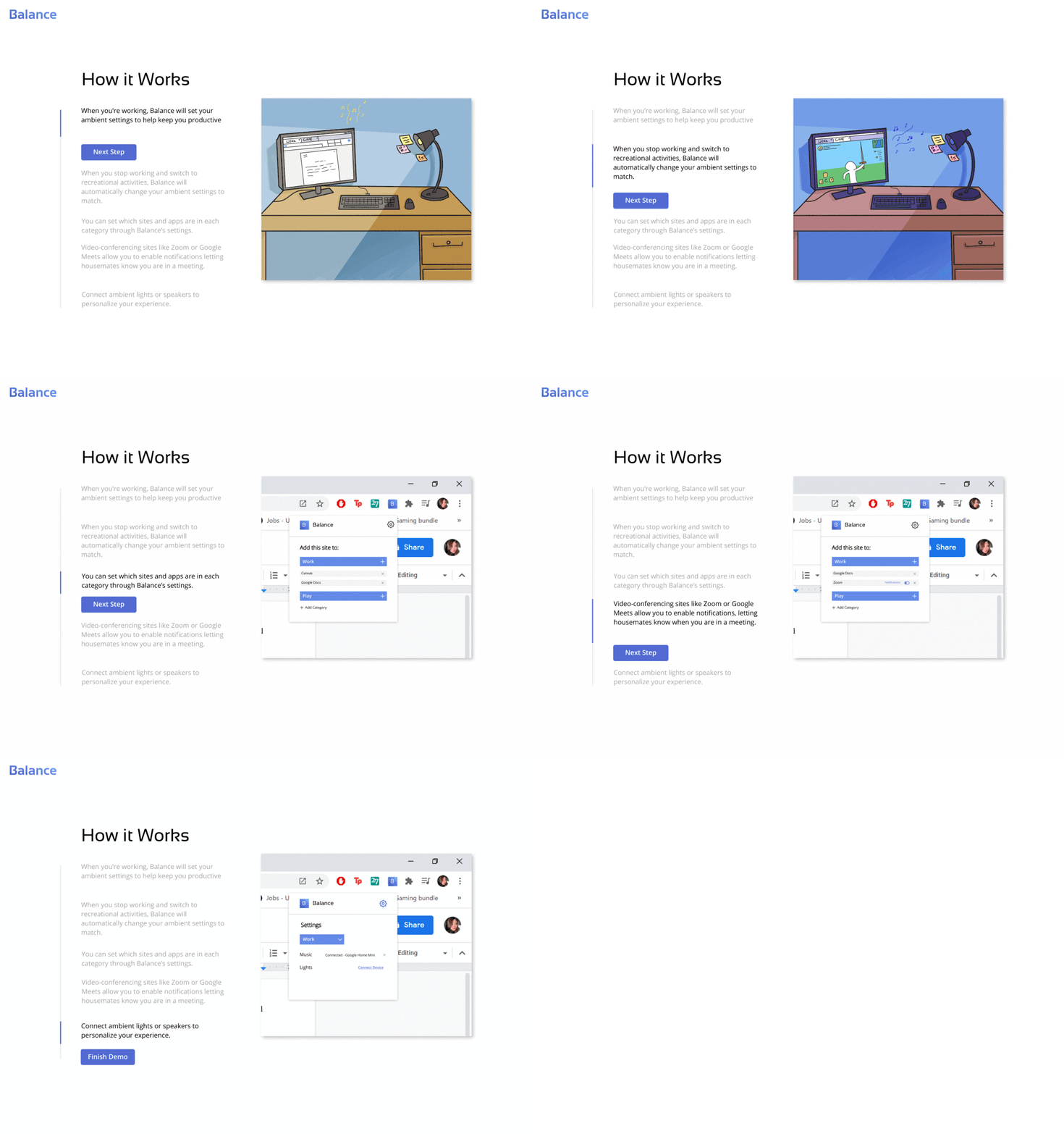
With successful user testing on our prototype, we moved on to creating the final iteration of this project - a fleshed out browser extension that would automate all the steps we did above.
Our extension Balance works by letting users essentially 'whitelist' different websites or desktop apps and tie to to specific lighting or musical playlists so that whenever they switched onto those apps/tabs, their environment would change with them. The settings are all entirely customizable as well - users can create their own settings, environments, and tab/app groups. Furthermore, they can add household members that would receive a quick text each time they need to join meetings.
Though this was the end of the project after this point, I still learned many skills and new approaches to problem solving. This was a more research heavy project and thus prompted me to learn new skills as I go (as I am primarily design focused). These skills have helped further my designs because I now have a better understanding of the entire end to end process. Additionally, the mentors at Sony really understood our teamwork logistics as they were once UCSD students as well - the aid and direction they gave us forced us to think outside of the box and to prevent tunnel-visioning. Overall, this may have been one of the most eye opening project teams I have worked on.